Consumer segmentation is a strategic exercise
Whether your are working on product innovation, market entry, or brand positioning, clearly defining your target audience(s) is non-negotiable.
Enter the segmentation analysis, the holy grail of consumer profiling. The idea is simple enough: partition the market –> prioritise your efforts –> profit.
However, there are many competing ways to split consumer groups in practice. Recall the famous adage attributed to George Box: "All models are wrong, but some are useful". Unfortunately, we see quite a few segmentation studies plagued by missteps rendering them less-than-useful.
The usual suspects are:¹
Insufficient context awareness: A rigid, standardised product not properly aligned with business objectives.
Over-indexing on demographics: Knowing who the consumer is says little about what makes them tick.
Ad hoc analysis: Unreliable pattern recognition constrained by human cognitive limitations.
No practical leverage: Analysis based on parameters that cannot reasonably be influenced by the business.
Lack of ownership: Stakeholders not properly involved.
The It depends flavour of survey-based quantitative consumer segmentation is based on 5 guiding principles to address the shortcomings above:
Strategic relevance
Psychographic grounding
Computational robustness
Actionable outcomes
Continuous co-creation
Strategic relevance
A useful consumer segmentation is basically a function of patterns + priorities. Statistics and interpretation will yield the patterns, but stakeholders must bring the priorities.
So, what is the business objective? Once we have the desired outcome nailed down, we break it into constituent parts and further down into the human attributes that drive them. Generally, the task is to induce some desired action or mindset shift in the target audience, so we must operationalise our objectives using parameters that the business could and would reasonably influence. Moving from ambitions to metrics in a principled manner ensures a through line in the analysis, connecting business goals to actual leverage.
For instance, we may be interested in identifying the Job-to-be-Done for a new product. We may want to explore drivers and barriers to customers using a specific offering. Or we may look for indicators of brand perception.
Our segmentation will rest on a combination of outcome parameters on the one hand and psychographic and behavioural drivers on the other.
Psychographic grounding
Many segmentation models suffer from an over-reliance on demographic characteristics – age, gender, education, geography, education level ... you get it. Such information may reveal something about who consumers are, yet it provides little direction on how to influence them.
Instead, we recommend starting from psychographics. That is: zeroing in on human needs, motivation, and behaviour. Similarities and differences along these foundational dimensions then form the basis for dividing people into distinct groups. Only later do we layer on demographics for description and tactical targeting.
We are usually interested in quantifying 3 distinct aspects of our consumers: Awareness, Attitudes, and Actions.²
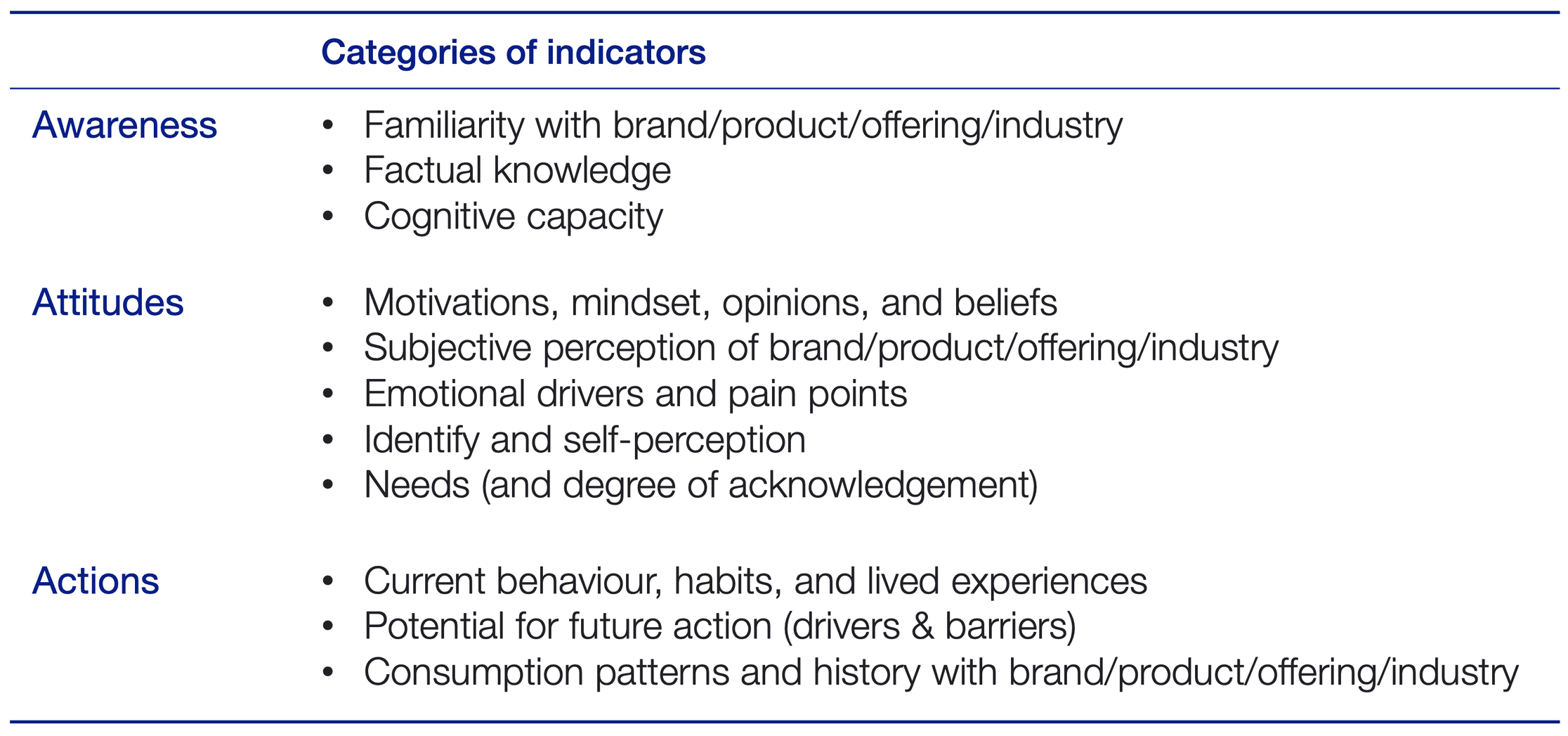
A non-exhaustive list of example indicators for each dimension. Each of these indiators can then be operationalised into several survey items.
Since the kinds of data required for psychographic analysis are very rarely on hand inside a CRM system, a market survey is often the best way forward.
To proceed, we operationalise Indicators into questionnaire items. Then, we field a survey among a sample representative of the market in question – and/or among the existing customer base. A combination of these two sampling approaches may prove especially powerful, since it provides a strong comparative perspective between current and potential customers.³
Computational robustness
A good statistical segmentation model splits consumers into clearly delineated groups using a reproducible workflow. This, we will handle using computational clustering techniques.
While our model will be built from parameters that we have hypothesised to be important, the process does remain explorative – in the sense that we cannot know with certainty beforehand which metrics will turn out to be the most useful.
Rather than relying solely on human judgement, we therefore need a principled way of summarising our data – to reduce complexity and to understand which indicators will form the corner stones of our segments. This will our first step, guided by statistical dimensionality reduction.
Identifying axes of difference
With a dataset in hand, you now have many potential indicators to assess; to include in or exclude from subsequent modelling. To guide this process, we identify key dimensions in the data using techniques such as Exploratory Factor Analysis (EFA) or Principal Component Analysis (PCA).
The idea here is to find a few axes that describe most of the variance across the dataset.⁴ If our operationalisation of psychographic concepts into survey items is well-designed, the resulting dimensions should correspond well to those concepts.
We can now either proceed with these raw dimensions in hand – or use them as guidelines to construct bespoke scales (i.e. metrics which combine multiple survey items to capture different facets of the underlying construct).
For simplicity's sake, imagine that our various indicators have adequately captured the aforementioned 3 As: Awareness, Attitudes, and Actions.
Grouping consumers based on mindset and behaviour
Clustering algorithms may be used to group survey respondents together based on their scores along each of our 3 key dimensions.⁵ People who look alike across dimensions get lumped together, while maximising the difference between the groups.
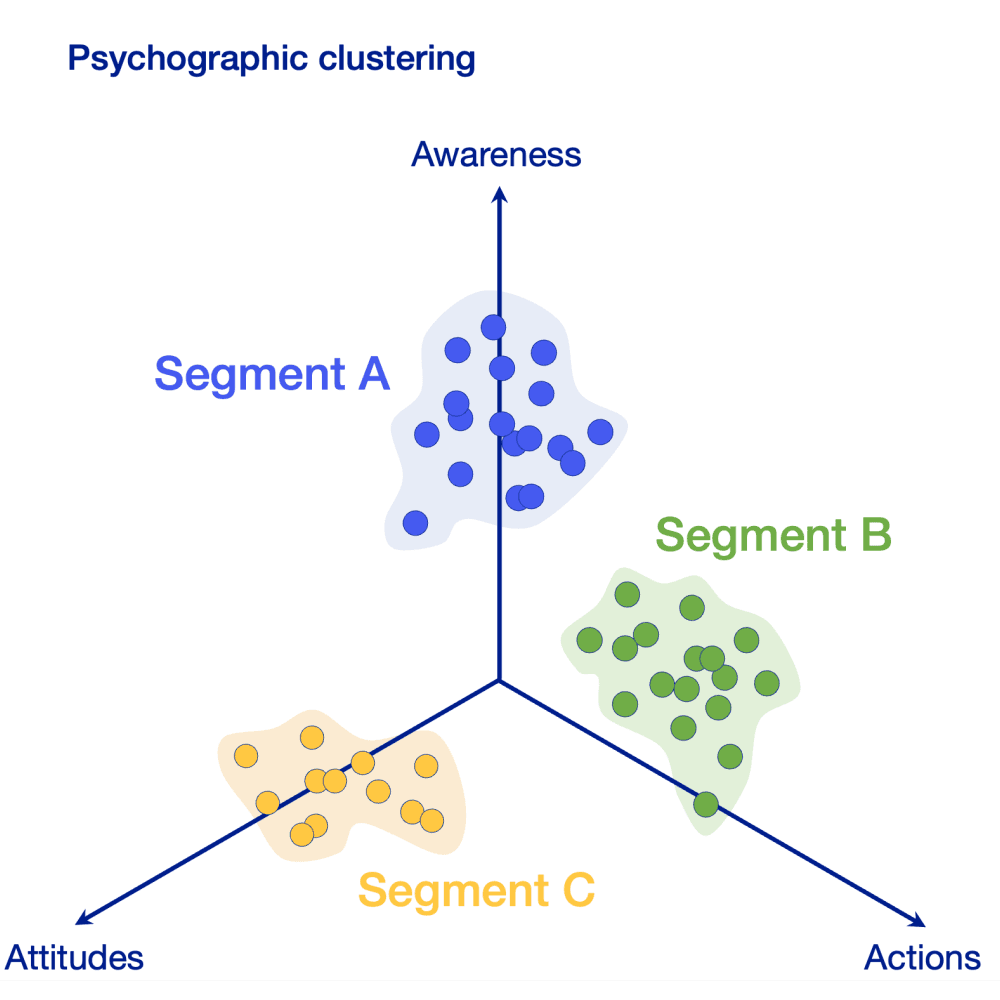
Clustering techniques lets us group together consumers with similar mental models and behavioural patterns
We end up with clearly delineated groups of people, sorted into buckets based on similarities in knowledge, motivation, and reported behaviour, as they explicitly relate to our business objective.
After this computational step, it is time to dial up the human interpretation once again.
Actionable outcomes
From these psychographic clusters, segment profiles emerge. Even a simple summary across segments – such as their average score along each key dimension – reveals fundamental differences. Clear splits among segments arise from the way we originally recovered the dimensions: by maximising variance.
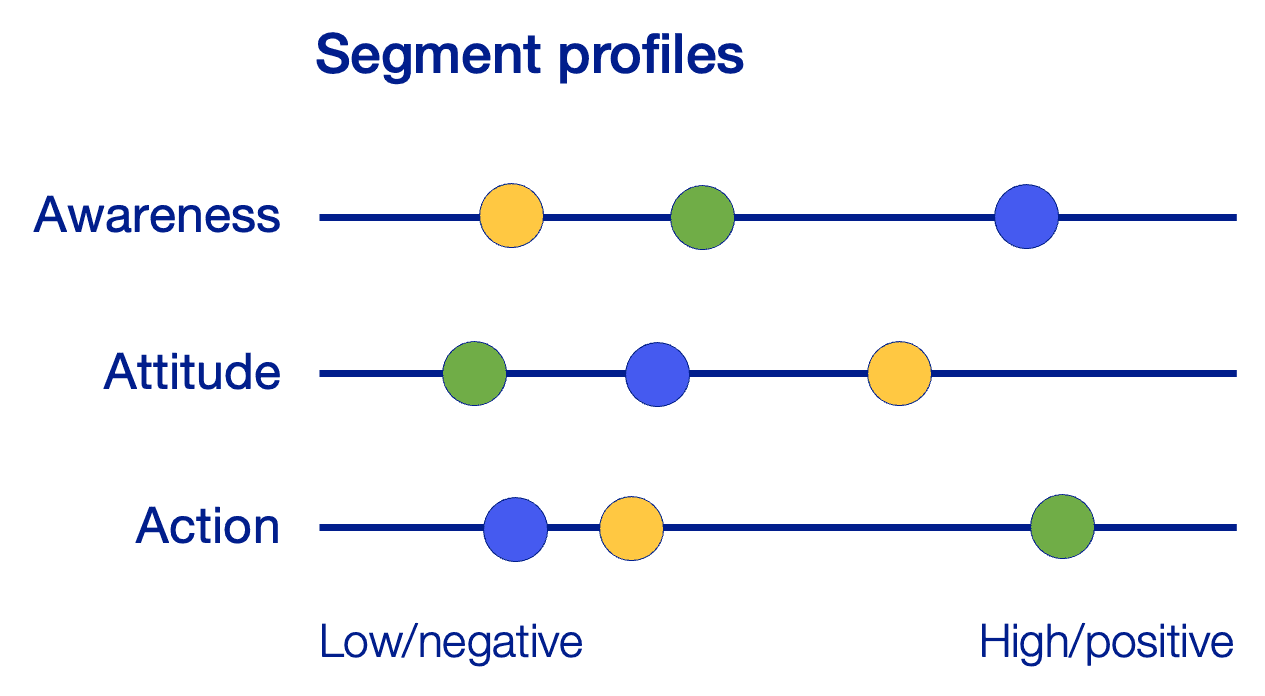
Average scores on key dimensions reveal just how different segments are.
At this point, we can enrich each segment with demographic characteristics, identify their respective sizes in the sample, and crosstabulate with relevant outcome variables. In this phase, additional information may also be taken into consideration, depending on availability, project scope, and research design: free-form survey input, interviews, CRM data, etc.
By fleshing out the segments in this way, we can also begin hypothesising about specific kinds of leverage that could be applied to each of them. We are now moving from pure description towards practical execution.
This process is only going to be as good as the research design allows. This is exactly why it is so important to measure parameters that the business can reasonably influence. Without relevant input, our model could describe the dataset very accurately, but it would still fall flat in the boardroom.
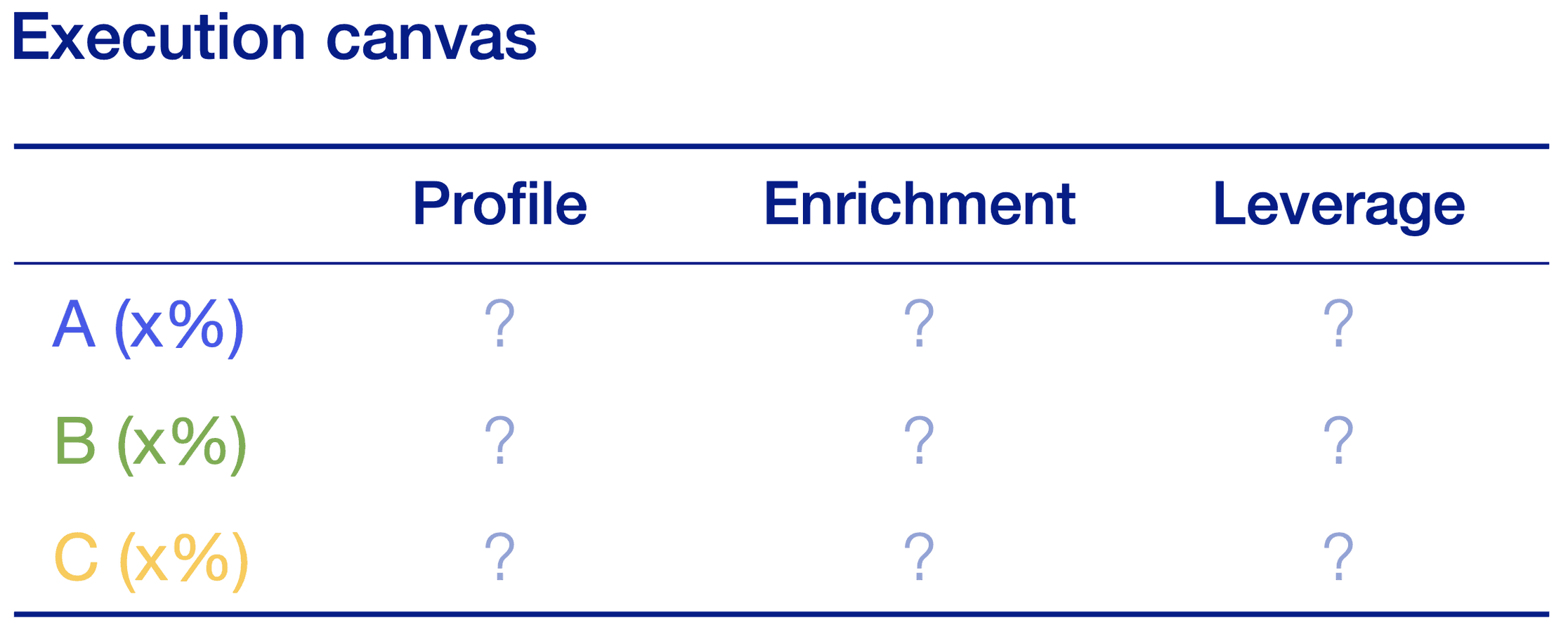
A simple framework to characterise each segment and strategise about how to tackle them.
At this point, we usually also want to extrapolate beyond the sample itself. Based on representative survey recruitment, we can quantify segment volumes 'out there' in the market. Internally, segments may be linked to CRM data, either directly (if sampling directly from the customer base) or by classification based on observed segment characteristics.
Continuous co-creation
To provide direction, anchor the analysis, and ensure organisational buy-in, the most succesful segmentation projects dedicate time to workshopping core steps of the analysis with key stakeholders.
This collaboration is especially important in the research design phase (scoping objectives, framing phenomena to investigate) and in the later stages (describing segments, building towards execution).⁶
While it may be tempting to completely outsource a project like this, some level of involvement is absolutely crucial. Business priorities, statistical modelling, and careful interpretation should all come together in a collaborative environment to produce actionable consumer segments.
What's next?
With robust consumer segments on the table, quite a few opportunities open up, depending on the context.
The next step could be conducting qualitative fieldwork to build 'thick' personas for each segment profile. It could be setting up a tracking framework to monitor segments over time. Or it could be feeding insights directly into strategy work, product development, or marketing personalisation.
No matter the exact path forward, you are building on top of a solid, explainable, and reproducible understanding of consumer mindsets.
Notes
Honourable mention: That one time when an in-house Insights Lead told us they wanted to just chuck some market research data into ChatGPT and hope for the best.
These 3 As will sound familiar to anyone who has worked with customer journeys. Similar frameworks have 5, or even 7, dimensions. What is important is that it provides inspiration for designing both intellectual, emotional, and behavioural indicators. A truly meaningful brainstorm can never happen in a vacuum.
Surprisingly often, consumer insights projects are plagued by selection bias. With a bit of careful research design, you can avoid ending up with findings that raise more questions than they answer.
This is not just some random feature, but actually a prerequisite for the next step of the analysis. If we have no idea what drives variance among respondents, neither a human analyst nor an algorithm will be able to place them into clearly defined groups later.
Although this article is obviously not a guide to the technical implementation of these methods, some examples of commonly used computational grouping techniques for multi-dimensional data are k-means clustering, DBSCAN, and Latent Class Analysis (LCA).
That being said – depending on priorities and on the level of quant literacy among the stakeholder landscape – we love bringing the whole gang together in the machine room and fine-tuning the statistical models live as well.